
Custom Book Slipcase Guide: Materials, Fit and Design Options
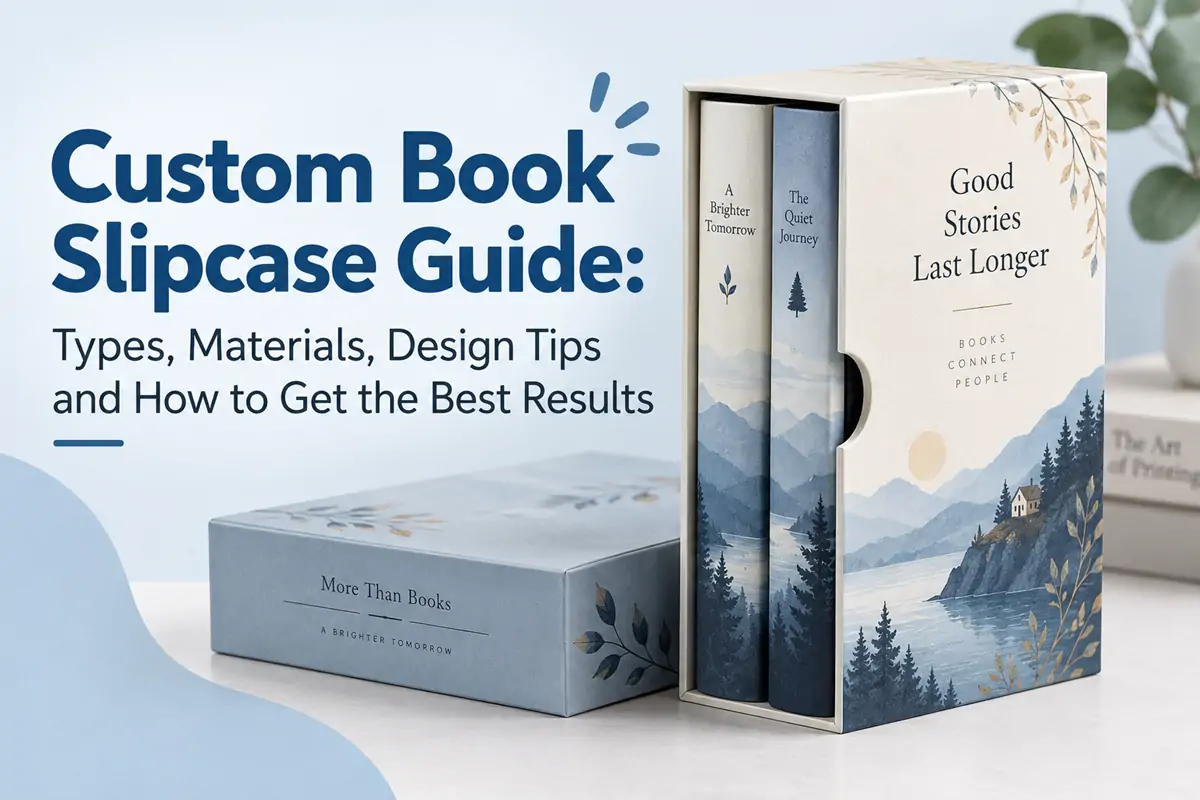
A custom book slipcase can turn a standard hardcover into a more complete retail product. It protects exposed surfaces, keeps multiple volumes together and gives publishers additional space for artwork, branding and special finishes.
However, adding a slipcase is not simply a matter of placing a book inside a rigid sleeve. The case must be designed around the book’s finished dimensions, cover material, spine shape and decorative features. If the fit is too tight, the cover or foil may be damaged during removal. If it is too loose, the book may shift, tilt or feel poorly made.
This guide explains when a slipcase is worth adding, how its structure works and which materials and finishes are suitable for different publishing projects.
What Is a Book Slipcase?
A book slipcase is a rigid, usually five-sided case with one open side. A single book or a coordinated set slides into the opening, leaving the spines visible and accessible.
Most custom slipcases are constructed from rigid board wrapped with printed paper, specialty paper, cloth or PU leather. The dimensions are made specifically for the finished book rather than selected from a standard stock size.
A slipcase should not be confused with a dust jacket or a fully enclosed presentation box:
A dust jacket is a removable printed paper cover wrapped around a hardcover.
A slipcase is a rigid, open-sided structure into which the book slides.
A presentation box usually encloses more sides of the product and may include a lid, hinged cover or magnetic closure.
Each option offers a different balance of protection, presentation, cost and opening experience.
When Does a Custom Book Slipcase Add Real Value?
Not every book needs a slipcase. For an economical paperback or a title intended for mass distribution, the additional materials, labor and shipping weight may not support the product’s retail position.
A slipcase becomes more valuable when it performs a clear commercial or practical function.
Collector’s and Limited Editions
Collectors often expect a special edition to feel different from the standard retail version. A coordinated slipcase helps create that distinction before the book is even removed.
It can be combined with features such as foil stamping, cloth covers, sprayed edges, gilded edges, ribbon markers or numbered edition pages. The slipcase does not need to repeat every finish used on the book; a restrained outer case can make a detailed book cover feel more significant.
Multi-Volume Book Sets
A slipcase keeps a trilogy, reference series or other multi-volume collection together. It also gives the set a unified shelf appearance when the individual volumes use different colors or cover designs.
For multi-volume projects, the total width must be calculated from finished production copies. Small variations in cover board, spine shape or page thickness can affect the final fit across the full set.
Art, Photography and Coffee Table Books
Large-format books often have wide covers and substantial weight. Their printed surfaces may be exposed to shelf wear, rubbing and handling.
A properly fitted slipcase can help protect the cover while supporting a premium retail presentation. The structure must still be strong enough for the book’s weight; a thin or poorly reinforced case may deform over time.
Corporate and Commemorative Books
Company histories, anniversary books, portfolios and commemorative publications are frequently presented as gifts rather than sold as ordinary books.
A slipcase creates room for corporate colors, logos, event dates or a short message without overcrowding the book cover. This allows the book itself to retain a more timeless design.
Subscription and Gift Editions
For a subscription-box brand or publisher-exclusive release, packaging is part of the unboxing experience. A slipcase can visually connect the book with inserts, bookmarks, cards or other printed components.
If the package contains several loose items, however, a fully enclosed presentation box with an insert may be more practical than a traditional open-sided slipcase.
Common Slipcase Covering Materials
The internal board provides the structure, while the outer wrapping material determines much of the appearance, texture and finishing compatibility.
Covering material | Visual character | Suitable projects | Important considerations |
|---|---|---|---|
Printed coated paper | Colorful, detailed and commercial | Illustrated editions, branded books and book sets | Usually laminated to improve surface resistance |
Specialty or textured paper | Refined and tactile | Literary editions, art books and minimalist designs | Color and texture can affect printed results |
Book cloth | Classic and premium | Collector’s editions, heritage titles and gift books | Often works best with foil, debossing or a label |
PU leather | Formal and substantial | Commemorative books and luxury-style editions | Grain, color and stamping performance should be sampled |
Mixed materials | Distinctive and highly customized | Deluxe editions and branded collections | Requires careful coordination of joints and tolerances |
Printed Paper Wrap
Printed coated paper gives designers the greatest freedom to use illustrations, photography, typography and full-color graphics. It is suitable when the slipcase should continue the book’s cover artwork or create a panoramic design across several surfaces.
Matte, gloss or soft-touch lamination may be added depending on the desired appearance. Dark solid colors require careful production control because scratches, glue marks and edge wear may be more visible.
Specialty Paper
Specialty paper can create a premium appearance without a complex printed design. Its color, fiber, texture or subtle sheen becomes part of the presentation.
This option is particularly effective for understated literary editions and art books. Because textured sheets do not always reproduce fine printing or solid ink areas in the same way as smooth coated paper, the artwork and finishing method should be selected for the actual material.
Cloth Wrap
Cloth creates a traditional, tactile finish commonly associated with premium hardcovers and collector’s editions. It can coordinate with a cloth-bound book or provide contrast to a printed cover.
Foil stamping, debossing or a mounted paper label can be used for titles and branding. Fine text and complex artwork should be tested because the cloth weave may influence edge sharpness.
PU Leather Wrap
PU leather can create a formal, leather-like appearance while offering a range of colors and surface grains. It may suit commemorative publications, premium journals and corporate gift editions.
Not every PU material reacts identically to foil stamping or debossing. A physical material sample and finishing test are helpful before the final design is approved.
How Should a Book Fit Inside the Slipcase?
Fit is one of the most important parts of slipcase production. The internal dimensions should be based on a finished physical book or confirmed production specifications—not only on the original cover layout.
The printer needs to consider:
Finished width, height and spine thickness
Square-spine or round-spine construction
Cover board thickness
Dust jacket thickness
Raised foil, embossing or other dimensional finishes
Number of books placed inside
Expected production tolerances
Direction in which the book will be inserted and removed
The book should slide out without excessive force but should not move noticeably when the slipcase is upright.
A finger notch or thumb cut can make removal easier, especially when the book sits nearly flush with the open edge. Another option is to position the book slightly proud of the case, although this changes both the visual appearance and the level of edge protection.
For a multi-volume set, separators may be considered if the books have delicate covers or if the design requires a structured arrangement.
Coordinating the Slipcase With the Book Design
The book and slipcase should be planned as one product, even when their artwork is different.
Three common design approaches are:
1. Continuous Artwork
An illustration or graphic system continues from the book onto the slipcase. This creates strong visual unity but requires accurate panel planning and alignment.
2. Deliberate Contrast
The book carries the detailed artwork while the slipcase uses a solid color, cloth texture or simple foil title. This approach can make the reveal more dramatic and prevent the complete product from appearing too busy.
3. Series Identity
For a multi-book set, the slipcase provides the main series branding while each volume receives its own color or cover illustration. This is useful when individual books may also be displayed separately.
Colors should be evaluated on the actual materials. The same digital color value may appear different on coated paper, uncoated specialty paper and cloth.
Finishing Options for a Custom Book Slipcase
A slipcase can support many of the same decorative techniques used on a hardcover case, including:
Gold or silver foil stamping
Embossing and debossing
Spot UV
Matte, gloss or soft-touch lamination
Printed patterns or illustrations
Mounted labels
Cloth or PU leather wrapping
Die-cut finger notches
Finishes should be selected according to the covering material rather than added only because they are available.
For example, spot UV is most effective when it creates contrast against a suitable printed and laminated surface. Foil can work well on paper, cloth or PU leather, but the stamping result depends on the texture and selected foil. Deep embossing or debossing must also be planned around the thickness and behavior of the material.
Slipcase vs Presentation Box: Which Should You Choose?
Choose a slipcase when:
The book spines should remain visible on a shelf.
Readers need quick access to the book.
Several volumes need to be kept together.
The packaging should feel premium without using a lid or closure.
The product is primarily a book rather than a gift set with many components.
Consider a presentation box when:
The book needs to be enclosed on all sides.
The package contains cards, prints or loose accessories.
A magnetic, hinged or lift-off opening is part of the experience.
The internal components require a fitted insert.
The product will be presented more like a boxed gift than a shelf-ready book set.
Neither structure is automatically better. The correct choice depends on the contents, retail position, shipping method and how the customer is expected to open and store the product.
What Affects the Cost of a Book Slipcase?
Slipcase pricing cannot be determined from the book quantity alone. The main cost factors include:
Finished internal and external dimensions
Number and weight of books inside
Board thickness
Covering material
Full-color printing requirements
Lamination and special finishes
Finger notches or other structural details
Assembly complexity
Order quantity
Individual packaging requirements
Shipping destination
A large coffee table book, for example, requires more board and wrapping material than a standard novel. Cloth wrapping and multiple foil areas also involve different production steps from a printed paper wrap.
The slipcase adds weight and volume to each unit, so international shipping and carton packing should be included when evaluating the complete project budget.
Common Slipcase Design Mistakes
Designing the Case Before Finalizing the Book
Changes to page count, paper thickness, cover board or binding can change the book’s finished dimensions. Finalizing the slipcase too early can create a fit problem.
Making the Fit Too Tight
A tight case may appear precise in a digital drawing but can make the book difficult to remove. It may also rub against foil, cloth or laminated surfaces.
Making the Fit Too Loose
Excessive clearance allows the book to lean or move inside the case. For a set, uneven gaps can make the complete product feel inconsistent.
Ignoring Material Behavior
Printed paper, cloth and PU leather do not fold, wrap or receive decorative finishes in exactly the same way. Artwork should be prepared for the selected material.
Adding Too Many Finishes
Using foil, embossing, spot UV, multiple textures and complex printed artwork together does not always create a more premium result. A clear hierarchy usually produces a stronger design.
Skipping the Physical Sample
A digital proof can confirm artwork and basic positioning, but it cannot fully demonstrate the grip, fit, texture, weight and removal experience of the finished structure. Physical sampling is particularly important for premium and multi-volume editions.
Custom Book and Slipcase Production With SeSe Printing
SeSe Printing produces custom hardcover books, special editions and coordinated slipcases for publishers, authors, designers and brands.
Available options include printed paper, specialty paper, cloth and PU leather coverings, together with foil stamping, embossing, debossing, spot UV and selected book-edge treatments. The book and its presentation structure can be managed under a coordinated production and quality-control process.
The standard minimum order quantity for custom books is 300 copies per design. Customers should provide complete print-ready artwork. High-resolution PDF files with embedded fonts and images and 3 mm bleed are preferred.